

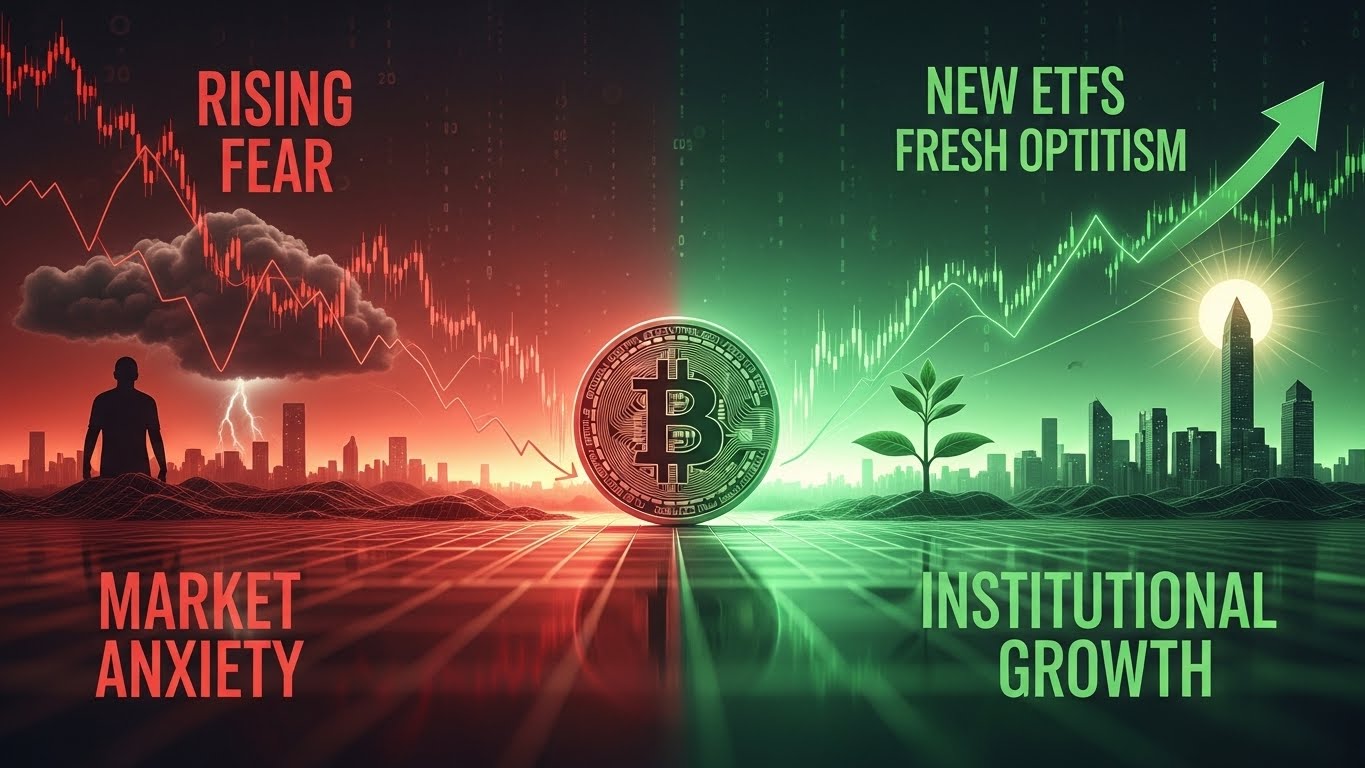
In the latest Bitcoin updates, the mood across the crypto market feels strangely divided. On one side, anxiety is everywhere. Traders refresh charts every few seconds, watching intense crypto market volatility and sudden dips that seem to come out of nowhere. Social media feeds are full of panic, speculation about regulation, and debates over whether we are on the edge of another major downturn.
On the other side, a quieter but powerful optimism is building. That optimism is centered on Bitcoin ETFs, especially spot Bitcoin ETF products that directly hold the cryptocurrency. For many, these exchange-traded funds mark a historic shift because they bridge the gap between traditional finance and digital assets. While prices swing wildly and sentiment heats up, institutional channels designed to support long-term adoption are slowly locking into place.
This tension between fear and hope is what makes the current environment so fascinating. Bitcoin updates: anxiety sweeps crypto market, yet ETFs ignite optimism for recovery is more than just a headline; it is a description of a deep psychological and structural shift happening in real time. In this article, we will explore why investors are so nervous, how Bitcoin ETFs are changing the narrative, what factors could drive a recovery, and how everyday participants can navigate this turbulent but opportunity-filled phase.
Bitcoin Updates: Why Anxiety Sweeps The Crypto Market
The Emotional Cycle Of Crypto Volatility
Anyone who has spent time following Bitcoin price moves knows that fear and greed are never far apart. Crypto market volatility is legendary. Double-digit percentage swings in a single day are not rare events; they are part of the asset’s personality. For newcomers, this feels shocking. For veterans, it is simply another chapter in the ongoing story of Bitcoin market cycles.
However, even experienced traders feel a different kind of pressure when the news flow turns negative. Discussions of crypto regulation, potential restrictions on exchanges, tax changes, macroeconomic uncertainty, or sudden liquidations can magnify every price move. In this environment, every red candle seems heavier, and every bounce appears suspicious.
This psychological pressure is why Bitcoin updates carry so much emotional weight. Each headline, each tweet, each analyst comment can push sentiment one way or the other. Anxiety grows when people feel they have no clear narrative, only unpredictable waves of information.
Macro Headwinds And Risk-Off Sentiment
Alongside crypto-specific factors, broader macroeconomic conditions also play a major role. When interest rates are high, liquidity is tight, or the global economy appears fragile, investors often move away from risky assets. Bitcoin and altcoins tend to be lumped into the “high risk” category, which means they can suffer when capital flows back into safer instruments.
In these moments, Bitcoin updates often reflect a chorus of concern. Analysts talk about correlations with tech stocks, fears of recession, or shifts in institutional risk models. Even if the underlying blockchain adoption remains strong, price action can still turn harsh because markets react not just to fundamentals, but to expectations and sentiment.
This combination of crypto-specific uncertainty and larger macro headwinds explains why anxiety sweeps the crypto market so easily. The environment feels fragile, and when people feel fragile, they interpret every new data point through a lens of fear.
ETFs Ignite Optimism: Why Bitcoin Funds Matter So Much

Understanding Bitcoin ETFs And Their Appeal
Amid the turbulence, one of the most important Bitcoin updates has been the growing role of Bitcoin exchange-traded funds. A Bitcoin ETF allows investors to gain exposure to the cryptocurrency’s price through a regulated, familiar financial product, without having to manage private keys, wallets or crypto exchanges themselves.
For traditional investors, this is a game-changer. Many large institutions, pension funds and conservative portfolios are not ready to directly custody Bitcoin on-chain. They have strict compliance requirements, internal risk rules and operational constraints. A spot Bitcoin ETF or a futures-based product fits neatly into their existing systems. It can be bought and sold like a stock, reported in a standard format and integrated into long-term portfolio strategies.
This is why Bitcoin ETFs ignite optimism for recovery even during periods of heavy selling. They are seen as an infrastructure layer, a bridge that makes it easier for very large pools of capital to enter the market over time. While day traders worry about the next hourly candle, institutional allocators think in terms of quarters, years and decades. Their presence can gradually stabilize and deepen liquidity.
Institutional Adoption And The Long-Term Narrative
As institutional investors show more interest in Bitcoin ETFs, the long-term narrative shifts from speculation to structural demand. Each new approval, each major asset manager launching a product or increasing holdings reinforces the idea that Bitcoin is becoming a recognized part of the global financial system.
This doesn’t mean that Bitcoin price will move in a straight line higher. Far from it. Even with strong institutional participation, market cycles will continue. But it does change the backdrop. Instead of being an outsider asset battling for legitimacy, Bitcoin increasingly looks like a volatile but accepted component of diversified portfolios.
When people talk about crypto recovery, this is what they often have in mind. A recovery is not just a price bounce; it is a shift toward foundations that make those prices more sustainable. Bitcoin ETFs are a key part of that foundation because they support regulated, transparent access to Bitcoin exposure for large and small investors alike.
Anxiety Vs. Optimism: Two Narratives Colliding
Short-Term Fear Meets Long-Term Vision
Right now, the market is experiencing a clash between two powerful narratives. The first is driven by fear. It focuses on recent losses, aggressive crypto liquidations, negative headlines and the possibility of further downside. The second is driven by confidence in Bitcoin’s long-term adoption, expanding crypto infrastructure and the growing role of exchange-traded funds.
When people read Bitcoin updates framed around sudden drops and scary predictions, the fearful narrative gains strength. When they see data about ETF inflows, institutional interest and technical progress on the underlying network, the optimistic narrative becomes more compelling. Both are true in different ways. The market’s job is to reconcile them through price discovery.
This is why investor experience varies so dramatically. Short-term traders, especially those using leverage, feel the full weight of crypto market anxiety. Long-term holders who focus on adoption metrics and technological advancements often feel cautious but hopeful. Bitcoin ETFs support the latter perspective by signaling that the asset is gradually integrating with mainstream finance.
Market Structure And Liquidity Dynamics
Beyond psychology, there is also a structural story. Bitcoin liquidity can thin out during periods of intense fear, making price movements more violent. Forced selling, margin calls and cascading liquidations can exacerbate a move that began with relatively modest selling pressure. These structural factors contribute to the perception that the crypto market is chaotic and unsafe.
On the other hand, as Bitcoin ETFs and other institutional channels grow, they can add depth to the market. Large, long-only funds might not react to short-term volatility in the same way as retail speculators. Their steady inflows or balanced allocations can help absorb shocks over time.
This doesn’t eliminate risk or volatility, but it changes the character of the market. Instead of being dominated by a relatively small group of highly reactive traders, Bitcoin begins to be influenced by a broader, more diverse set of participants. That is one of the reasons ETFs ignite optimism for recovery, even when immediate price action looks discouraging.
Key Drivers Behind The Latest Bitcoin Updates
Regulatory Developments And Policy Signals
Regulation is one of the most important themes in Bitcoin updates. When regulators clarify rules, approve new products or outline comprehensive frameworks, markets respond. Positive or clear regulation can reduce uncertainty and encourage more institutional participation. Conversely, harsh or unpredictable policy moves can trigger panic selling and capital flight.
The approval and growth of Bitcoin ETFs are themselves major regulatory milestones. They signal that authorities recognize Bitcoin as an asset that can be packaged into investor-friendly products, even if they still scrutinize other parts of the crypto ecosystem. This dual stance explains part of the mixed sentiment: some segments feel embraced, while others feel under pressure. In the coming years, the evolution of crypto regulation will continue to shape how confident investors feel. Clarity tends to support long-term adoption, while ambiguity amplifies anxiety. Understanding this dynamic helps explain why each new legal development is so closely reflected in Bitcoin updates across financial media.
Halving Cycles, Supply Dynamics And Market Expectations
Another key driver is Bitcoin’s fixed supply and predictable issuance schedule. The Bitcoin halving—a programmed event where block rewards are cut roughly in half every few years—plays a crucial role in how people interpret Bitcoin updates. Historically, halvings have often been associated with long-term bullish cycles, although the path has never been smooth.
As each halving approaches, analysts debate how reduced supply growth might affect Bitcoin price, especially if demand remains steady or increases through channels like ETFs. The narrative of digital scarcity is central to Bitcoin’s investment thesis. When combined with growing institutional access, it creates a powerful story of gradually tightening supply meeting gradually expanding demand.
Of course, markets are forward-looking. Sometimes prices soar before an event, only to correct later. Other times they move more slowly. Still, the underlying logic remains clear: Bitcoin’s fixed supply and global demand make it an asset where supply-side factors can have a profound impact over time. This is one more reason why, even during a fearful phase, many observers see a path toward recovery.
How Investors Can Navigate Anxiety And Opportunity
Building A Long-Term Perspective
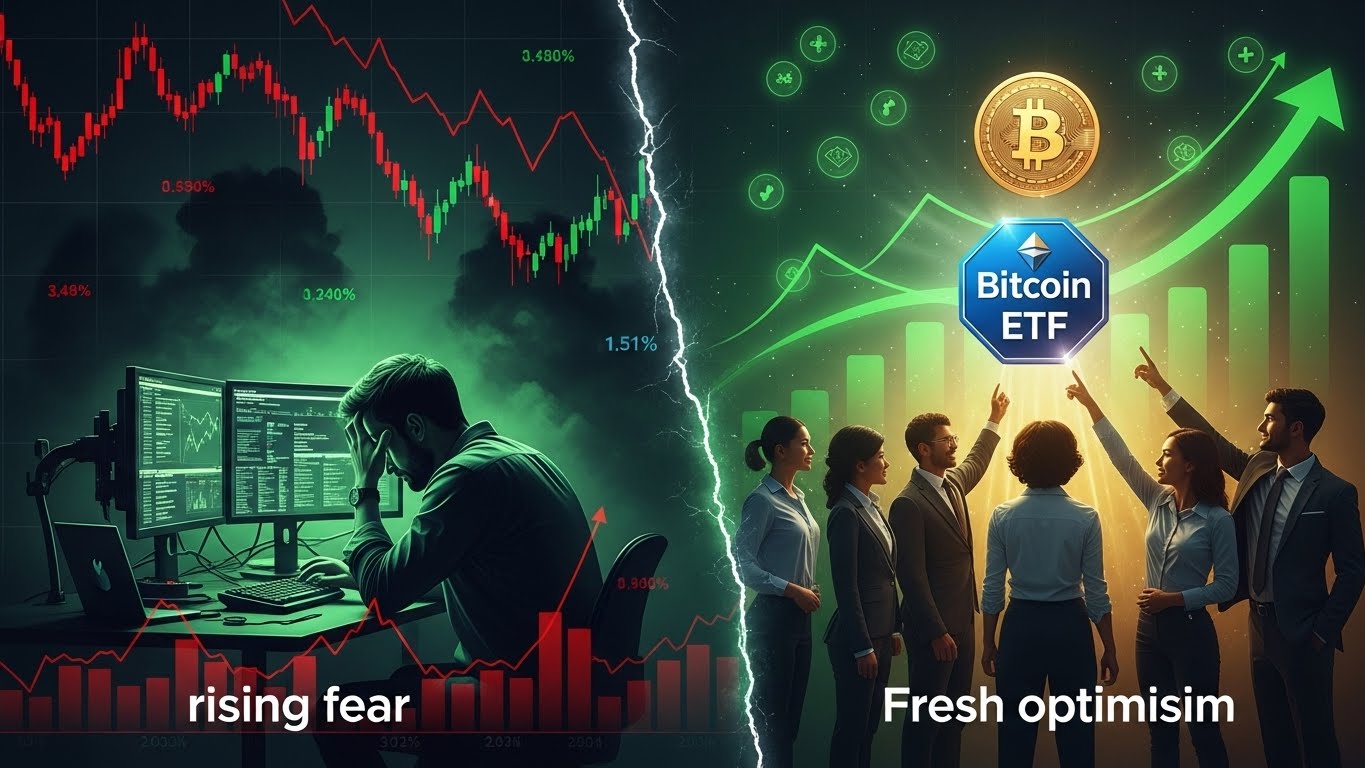
Staying calm during intense crypto market volatility is not easy, but it is essential. One practical approach is to focus on long-term trends rather than short-term noise. Instead of reacting to every negative headline, investors can ask deeper questions: Is Bitcoin adoption increasing? Are more institutional players gaining exposure through Bitcoin ETFs? Is the underlying network continuing to function and improve?
By grounding decisions in long-term fundamentals rather than immediate emotion, investors can avoid many of the traps that anxiety sets. They can also recognize that corrections and drawdowns, while painful, are part of the historical pattern of how Bitcoin has moved from a niche experiment to a globally recognized digital asset.
Understanding Risk And Personal Strategy
At the same time, optimism should not be confused with recklessness. Crypto assets are still risky, and no amount of ETF growth can change that fact overnight. Each individual or institution needs a strategy that reflects their risk tolerance, time horizon and financial goals. For some, Bitcoin might serve as a small allocation within a broader portfolio, a hedge against monetary debasement or a way to participate in digital asset innovation. For others, it may be too volatile or unfamiliar to hold directly. In those cases, Bitcoin ETFs can provide a controlled, regulated path to participation.
The key is intentionality. Anxiety often grows when people invest without a plan and then feel surprised by volatility. A clear, thoughtful approach to allocation can reduce stress and make Bitcoin updates easier to interpret, even in stormy conditions.
Conclusion
Right now, the phrase “Bitcoin updates: anxiety sweeps crypto market, yet ETFs ignite optimism for recovery” captures the essence of a pivotal moment. On the surface, fear dominates. Prices swing wildly, news cycles amplify every downturn and skeptical voices grow louder. Beneath the surface, however, a different story unfolds.
That deeper story is about Bitcoin ETFs, institutional integration, regulatory milestones and the gradual normalization of Bitcoin within the global financial system. It is about long-term demand channels being built even as short-term traders struggle with sharp corrections. It is about technological resilience, digital scarcity and the continued evolution of the crypto ecosystem.
The outcome of Bitcoin’s journey is still unwritten. But the coexistence of anxiety and optimism is not a contradiction; it is a sign of transition. Markets are learning how to price a new kind of asset that challenges old assumptions but increasingly fits into old frameworks like ETFs and regulated investment products.
For investors and observers, the challenge is to see both sides clearly. Acknowledge the risks, understand the volatility, and respect the emotional weight of downturns. At the same time, recognize the structural shifts that may lay the foundation for future recovery and growth. In that balance, the story of Bitcoin updates becomes not just a record of price swings, but a narrative of how the world learns to live with, and potentially thrive on, digital scarcity in a connected age.
FAQs
Q: Why is there so much anxiety in the current Bitcoin market?
There is heightened anxiety in the current Bitcoin market because several forces are hitting at the same time. Price swings remain extreme, and every downturn is amplified by social media and news headlines. Concerns about crypto regulation, macroeconomic uncertainty, and the safety of exchanges and lending platforms contribute to a feeling of instability. Many investors are still recovering emotionally and financially from previous crashes, so they react strongly to any sign of renewed weakness. Together, these factors create a climate where Bitcoin updates are often read through a lens of fear, even when underlying adoption trends may still be positive.
Q: How do Bitcoin ETFs help reduce fear and support recovery?
Bitcoin ETFs help reduce fear by offering a familiar, regulated way for investors to gain exposure to Bitcoin without dealing directly with private keys, wallets or crypto exchanges. They can be bought and sold through existing brokerage accounts, making the asset more accessible to institutions and traditional investors. This added accessibility can deepen liquidity and create more stable demand, especially from long-term allocators who are less likely to panic during short-term volatility. When people see strong inflows into spot Bitcoin ETF products and other exchange-traded funds, it reinforces the idea that large, serious players view Bitcoin as a legitimate asset, which supports optimism for a more durable recovery.
Q: Are Bitcoin updates about ETFs only relevant to institutional investors?
No, Bitcoin updates about ETFs are relevant to both institutional and retail investors. While institutional investors may be the primary users of these products at first, their participation affects the entire crypto market. More institutional involvement can mean deeper liquidity, more research and analysis, greater regulatory clarity and a broader range of financial products built around Bitcoin exposure. Retail investors may also benefit indirectly, as the presence of Bitcoin ETFs often signals growing acceptance of digital assets by mainstream finance. In some regions, even individual investors can buy ETF shares directly, using them as a simpler gateway to Bitcoin than managing on-chain transactions themselves.
Q: What role does regulation play in Bitcoin’s future recovery?
Regulation plays a crucial role in shaping Bitcoin’s future. Clear, consistent and fair rules can reduce uncertainty, encourage institutional participation and protect consumers from the worst forms of fraud and abuse. Approvals of Bitcoin ETFs and other regulated products suggest that policymakers are willing to integrate Bitcoin into traditional frameworks, even as they remain cautious about other parts of the crypto ecosystem. On the other hand, overly harsh or unpredictable regulation can push activity offshore, suppress innovation and fuel additional market anxiety. The balance regulators strike will influence how quickly and confidently capital flows into Bitcoin over the long term, affecting the strength and durability of any future recovery.
Q: How can an individual investor stay calm during volatile Bitcoin updates?
An individual investor can stay calmer during volatile Bitcoin updates by focusing on long-term goals, understanding their own risk tolerance and maintaining a clear strategy. Instead of reacting impulsively to every price move or headline, it helps to zoom out and examine broader trends such as Bitcoin adoption, institutional interest, network health and the growth of Bitcoin ETFs. Allocating only what one can afford to lose, avoiding excessive leverage, and regularly revisiting personal reasons for holding Bitcoin can reduce emotional stress. Education is also a powerful tool; the more an investor understands about crypto market dynamics, the easier it becomes to interpret volatility as part of a larger cycle rather than a personal catastrophe.
