


The global cryptocurrency market is once again buzzing as Coinbase and Bithumb list new altcoins and expand their trading offerings. After a bruising bear market and a series of high-profile failures, many investors had retreated to Bitcoin, Ethereum and a few blue-chip assets. Now, with liquidity slowly returning and sentiment turning more optimistic, major exchanges are signaling cautious confidence by adding fresh tokens to their platforms. Coinbase continues to broaden its supported assets in the United States and globally, while Bithumb, one of South Korea’s largest exchanges, actively introduces new altcoin trading pairs to capture rising demand.
These moves are not random. New listings often coincide with improved trading volume, greater stablecoin inflows and renewed appetite for risk among crypto investors. At the same time, they highlight the delicate balance exchanges must strike between innovation and investor protection. A new altcoin listing can create excitement and short-term price spikes, but it can also expose inexperienced traders to heightened volatility and project-specific risks.
This article offers a detailed, yet accessible, look at why Coinbase and Bithumb list new altcoins during a period of recovering investor confidence, what these listings signal about broader crypto market recovery, and how traders can navigate this environment with a healthy dose of caution.
Coinbase and Bithumb in the Modern Altcoin Cycle
The decision by Coinbase and Bithumb to list new altcoins is part of a longer story about how centralized exchanges shape the altcoin market cycle. Both platforms serve as crucial gateways into the world of digital assets, especially for retail investors who prefer regulated, user-friendly interfaces over decentralized exchanges.
Coinbase has built its brand around regulatory compliance and accessibility for Western markets. When it adds new cryptocurrencies or altcoin futures, those listings are often interpreted as a form of institutional validation, sometimes even dubbed the “Coinbase effect” because many tokens rally sharply when trading begins. Bithumb, on the other hand, plays a key role in South Korea’s highly active trading scene. Korean investors have historically shown strong interest in emerging altcoins, and Bithumb’s new listings frequently trigger noticeable price movements, with some tokens hitting multi-month highs shortly after launch.
The Role of Major Crypto Exchanges in Altcoin Discovery
Major exchanges like Coinbase and Bithumb act as discovery engines in the altcoin ecosystem. Thousands of tokens exist across various blockchains, but only a fraction gain the visibility that comes with a large centralized listing. When Coinbase and Bithumb list new altcoins, they effectively curate opportunities for a broad audience, filtering candidates based on factors such as compliance, security, liquidity and perceived demand.
For many investors, an exchange listing is the first time they encounter a project. The presence of an altcoin on a well-known platform can suggest that the token has passed at least basic due diligence. However, it is critical to remember that an exchange listing is not a guarantee of long-term success. A project might have strong marketing and community hype but weak fundamentals, opaque governance or unreliable tokenomics.
From Bear Market Angst to Cautious Recovery
The current wave of new listings from Coinbase and Bithumb comes after a period marked by bankruptcies, regulatory crackdowns and sharp drawdowns in altcoin prices. During the depths of the bear market, many exchanges slowed listings, tightened risk controls and focused on core assets.
As on-chain data and market reports now show rising liquidity, improved derivatives activity and stronger stablecoin inflows, exchanges are starting to respond by expanding their menus of tradable instruments, including niche DeFi tokens, Web3 projects and AI-related cryptocurrencies.
Yet the tone is more measured than in past bull runs. The emphasis is shifting toward “quality growth” and better investor education, which is why a cautious analysis of these trends is so important.
Why Coinbase and Bithumb Are Listing New Altcoins Now
When Coinbase and Bithumb list new altcoins amidst recovering investor confidence, they are responding to both market demand and strategic pressures. Exchanges compete for users, volume and fee income, and fresh listings are a powerful way to attract attention and keep traders engaged.
Demand for Diversification and Innovation
After extended periods of sideways or downward price action, many investors look beyond major coins in search of higher potential returns. New narratives such as layer-2 scaling, decentralized infrastructure, real-world asset tokenization, Web3 gaming and AI-driven crypto protocols have created a pipeline of projects seeking liquidity and visibility.
Coinbase taps into this demand by adding promising tokens that appear to meet its internal standards on security, compliance and utility. Bithumb does something similar within the Korean market, focusing on projects that resonate with local traders and can quickly build KRW trading pairs with sufficient order book depth.
For investors, these listings represent opportunities to diversify portfolios beyond established coins. However, diversification must be balanced against the higher risk profile of newer projects, which can be more vulnerable to market swings and liquidity shocks.
Competition, Liquidity and Fee Revenue
Exchanges generate significant revenue from trading fees, especially in altcoin spot and derivatives markets. As new competitors emerge and decentralized platforms gain traction, established exchanges need to keep their offerings fresh. Listing attractive altcoins is one of the most straightforward ways to increase trading volume and retain active users.
Liquidity is another factor. When Coinbase lists a token already trading elsewhere, or Bithumb introduces a coin popular on other Asian exchanges, they tap into existing demand and attract arbitrage traders. This, in turn, deepens liquidity and can make the platform more appealing for market makers and institutional participants.
Yet there is a trade-off. Listing too many speculative tokens could invite regulatory scrutiny or reputational damage, particularly if a high-profile altcoin collapses or faces legal challenges. Therefore, Coinbase and Bithumb must carefully balance the short-term benefits of new listings with long-term trust and compliance.
The Market Impact of New Altcoin Listings

When Coinbase and Bithumb list new altcoins, the immediate effect is often visible in price charts and social media buzz. Many tokens experience a “listing pop,” a sudden increase in price and volume as traders rush to position themselves.
Short-Term Price Spikes and the Listing Effect
Analysts often refer to the “listing effect” to describe how prices move when a token appears on a major exchange. The effect is particularly strong when the token previously had limited accessibility and suddenly becomes available to millions of new users. Short-term traders and algorithmic strategies may front-run or quickly respond to announcements, generating volatility around the listing date.
On Bithumb, new listings have repeatedly sparked strong short-term rallies as local demand pours in, especially for tokens tied to trending narratives. Similar patterns are observed when Coinbase lists new spot or futures markets, with some tokens gaining double-digit percentages in a matter of hours.
While these moves can be profitable, they can also be dangerous for late entrants. Prices may retrace once initial excitement fades, leaving momentum buyers exposed to steep drawdowns.
Long-Term Performance: Fundamentals Over Hype
Over longer timeframes, the success of a newly listed altcoin depends far less on which exchange it appears on and far more on its underlying fundamentals. Important factors include the project’s real-world use cases, developer activity, governance structure, token distribution, and ability to build a sustainable ecosystem.
Some tokens maintain or even expand their gains months after listing, especially when they deliver on roadmaps, secure partnerships and show strong on-chain activity. Others gradually lose liquidity and fall out of favor, even if they remain listed on major platforms. Historical data shows that not every newly listed asset outperforms; many eventually underperform blue-chip cryptocurrencies despite an explosive start.
For cautious investors, the key is to see exchange listings as a starting point for deeper research, not as the final stamp of approval.
Key Risks Behind New Altcoin Listings
Although the fact that Coinbase and Bithumb list new altcoins may signal growing confidence, it does not eliminate risk. In reality, new listings can concentrate several types of crypto investment risk in a short window.
Volatility and Liquidity Traps
Newly listed altcoins frequently exhibit extreme volatility. Order books can be thin, spreads wide and large orders capable of moving the market dramatically. Even on reputable exchanges, slippage can be severe during the early trading phase, especially when speculative demand outpaces available supply.
This environment can create liquidity traps, where traders enter positions at inflated prices during the hype peak and find it difficult to exit without realizing significant losses. Stop-loss strategies may be less effective if price gaps occur between order levels. As a result, investors must approach early trading with conservative position sizes and realistic expectations about volatility.
Regulatory and Delisting Risks
Regulation is an increasingly important theme as authorities scrutinize altcoin offerings, exchange practices and token classifications. Coinbase operates under close observation from US regulators, while Bithumb is subject to Korean financial oversight, including rules on customer protection and anti-money-laundering.
If a token later raises compliance concerns or becomes the subject of legal action, exchanges may choose to suspend or delist it. Such decisions can sharply reduce liquidity and access, causing sudden price shocks. Investors who fail to monitor regulatory developments risk holding assets that become difficult to trade.
Smart Contract, Technical and Governance Concerns
Many new altcoins are tied to DeFi protocols, layer-2 networks or Web3 applications that rely heavily on smart contracts. Bugs, exploits and misconfigurations can result in lost funds or project failure. Even with audits, no complex codebase is completely risk-free.
Beyond technical issues, governance is another concern. Some projects use centralized decision-making, while others rely on DAO structures. Concentrated token holdings or opaque governance processes can create situations where insiders exert disproportionate control, potentially acting against the interests of smaller investors. A cautious analysis requires looking at smart contract audits, team track records, decentralization levels and community oversight mechanisms before committing capital.
How Investors Can Approach New Listings Cautiously
The fact that Coinbase and Bithumb list new altcoins amidst recovering investor confidence does not mean every new token is a good investment. However, with a thoughtful approach, investors can use these events as opportunities to learn, diversify selectively and manage risk.
Researching Tokenomics and Real Utility
A foundational step is understanding a project’s tokenomics. This includes total supply, emission schedule, vesting periods for team and early backers, and the actual use of the token within the ecosystem. Tokens with aggressive unlock schedules or highly concentrated ownership may be more vulnerable to sharp sell-offs. Equally important is assessing the genuine utility of the project. Ask whether the protocol solves a real problem, has a clear value proposition and is gaining users. Metrics such as active addresses, total value locked (TVL) for DeFi protocols, and developer activity can offer clues about long-term viability.
Evaluating Exchange Signals Without Blind Trust
An exchange listing is a signal, but not a guarantee. Coinbase and Bithumb perform their own due diligence, and their decisions may reflect robust internal processes. Still, they are commercial entities whose incentives include growth and trading revenue.
Investors should therefore treat listings as one indicator among many. Combining exchange signals with independent research, community feedback and third-party analysis helps create a more balanced view. Paying attention to how quickly other exchanges add the same asset can also provide hints about broader confidence or, conversely, caution in the market.
Risk Management and Portfolio Construction
Prudent risk management remains the backbone of any altcoin strategy. Position sizing should reflect the higher risk associated with new listings. Many investors limit exposure to speculative tokens to a small portion of their overall crypto portfolio, keeping the bulk in more established assets. Using staggered entries rather than chasing the first minutes of trading can reduce the impact of initial volatility. Having clear rules for taking profits or cutting losses, and avoiding excessive leverage, are essential practices in a market where prices can move rapidly in both directions.
What the Listings Reveal About Recovering Investor Confidence
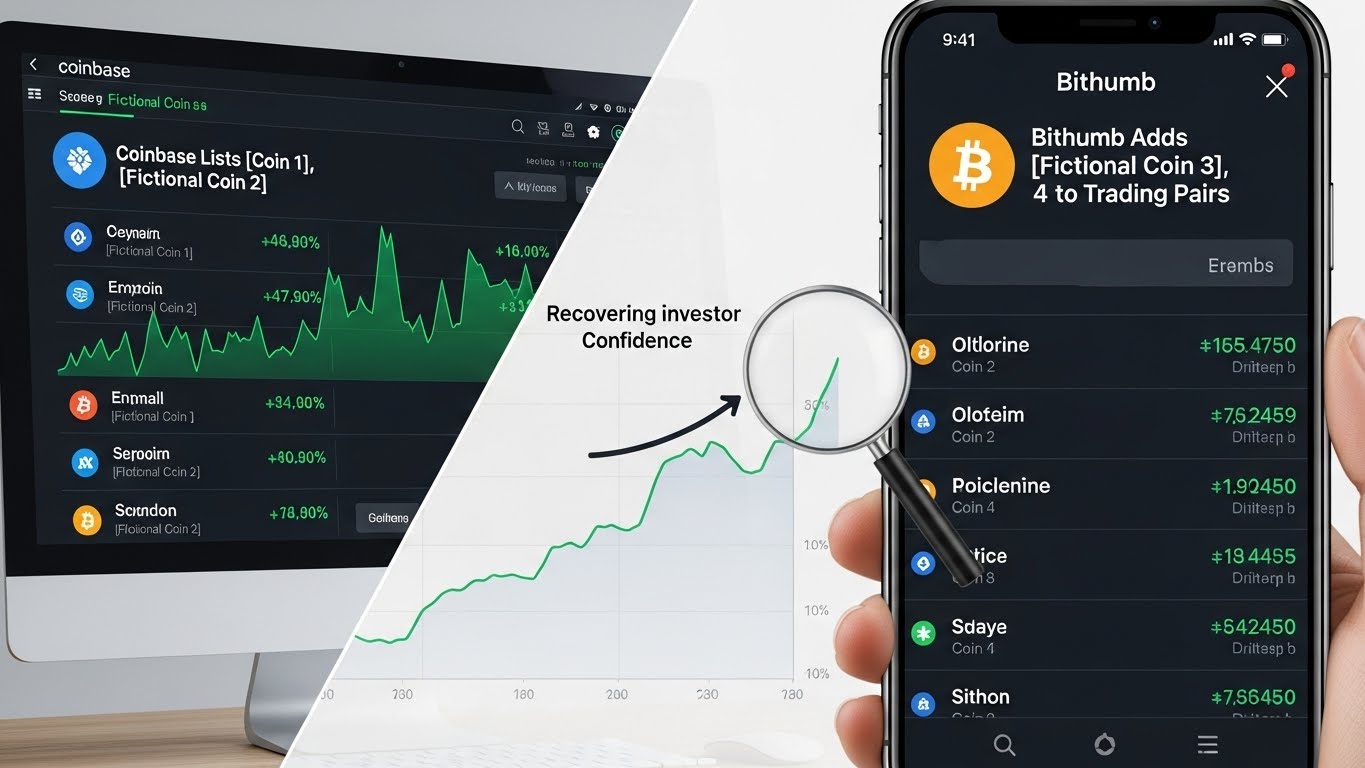
The fact that Coinbase and Bithumb list new altcoins at a faster pace than they did during the most fearful phases of the bear market is a strong sign that market sentiment is healing. At the same time, the tone of the recovery appears more cautious and selective than past frenzies.
Gradual Normalization Rather Than Full Euphoria
Market data suggests a gradual normalization: higher volumes, improving derivatives activity and more capital rotating into mid-cap and small-cap altcoins, but without the indiscriminate mania of earlier cycles. Exchanges are highlighting themes like infrastructure, AI, real-world assets and cross-chain liquidity, emphasizing tokens that align with longer-term narratives rather than pure meme speculation.
Investors seem more aware of risk, asking tougher questions about fundamentals and sustainability. This profile of cautious optimism fits well with the current pattern of listings and could support a more durable recovery if macroeconomic conditions remain supportive.
Regional Dynamics: US Versus South Korea
Coinbase and Bithumb also reveal how regional dynamics shape the altcoin landscape. In the US and Europe, Coinbase listings often focus on projects that strive for regulatory clarity and institution-friendly structures. In South Korea, Bithumb’s listings cater to a dynamic retail trading culture and can cause sharp, short-term price reactions when new KRW pairs go live. Together, these exchanges help define what “recovering confidence” looks like in different parts of the world, from cautious institutional interest to energetic retail speculation.
Future Outlook: Will the Listing Wave Continue?
If current trends persist, it is likely that Coinbase and Bithumb will continue to list new altcoins, especially those tied to key growth sectors like DeFi, infrastructure, AI, gaming and payment solutions. The pipeline of projects vying for exchange access remains large, and competition among platforms ensures that listings will remain a critical tool for user acquisition and brand differentiation.
However, the speed and aggressiveness of future listings will depend on macro factors, regulatory developments and market behavior. A renewed wave of speculative excess or major security incidents could prompt exchanges to tighten their standards once again. Conversely, steady adoption and clearer regulatory frameworks might encourage a more systematic integration of innovative tokens into mainstream platforms. For investors, the most sustainable strategy is to treat each new listing not as a guaranteed opportunity, but as an invitation to perform deeper analysis within a disciplined risk framework.
Conclusion
The headline that Coinbase and Bithumb list new altcoins amidst recovering investor confidence captures a pivotal moment in the ongoing evolution of the cryptocurrency market. New listings showcase emerging technologies, fresh narratives and renewed demand for diversification, while also underscoring the crucial role that major exchanges play in shaping liquidity and discovery in the altcoin ecosystem.
Yet beneath the excitement lies a complex set of risks: volatility, liquidity imbalances, regulatory uncertainty, technical vulnerabilities and governance challenges. A cautious analysis reveals that while exchange listings can open doors to genuine innovation and long-term growth, they can also magnify the dangers of hype-driven speculation.
For investors, the path forward lies in combining curiosity with discipline. Use listings on Coinbase and Bithumb as starting points for research, not endpoints. Focus on fundamentals, risk management and realistic expectations. In doing so, you can participate in the opportunities presented by a recovering market while avoiding many of the pitfalls that have defined previous cycles.
Q: How do new altcoin listings on Coinbase and Bithumb affect prices?
New altcoin listings on major exchanges like Coinbase and Bithumb often trigger short-term price spikes driven by increased visibility, sudden access to a larger pool of traders and speculative demand. This so-called listing effect can result in rapid gains around the launch of trading, but it is frequently followed by volatility and potential pullbacks as early buyers take profits. Over the long term, price performance depends more on the project’s fundamentals, adoption and execution than on the listing itself.
Q: Does a Coinbase or Bithumb listing mean an altcoin is safe to invest in?
A listing on Coinbase or Bithumb indicates that the token has passed certain internal checks related to security, compliance and technical integration, but it does not guarantee safety or long-term success. Exchanges are businesses that benefit from trading activity, and even well-vetted projects can face regulatory challenges, technical issues or market failures. Investors should treat a listing as one positive signal among many and still conduct their own research into tokenomics, use cases, team background and risk factors.
Q: Why are Coinbase and Bithumb listing more altcoins during a market recovery?
As investor confidence improves and trading volumes recover, demand rises for diversified exposure beyond Bitcoin and Ethereum. Coinbase and Bithumb respond by listing new altcoins that align with emerging narratives such as DeFi, Web3, infrastructure and AI. These listings help exchanges attract users, deepen liquidity and increase fee revenue. At the same time, they are typically more selective than in past euphoric phases, aiming to balance innovation with regulatory and reputational considerations.
Q: What should I check before trading a newly listed altcoin?
Before trading a newly listed altcoin, it is wise to examine the project’s tokenomics, including total supply, vesting schedules and distribution among team members and early investors. You should also look at the project’s real-world utility, roadmap progress, developer activity, security audits and governance model. Understanding market conditions, such as order book depth and historical price behavior on other exchanges, can help you gauge potential volatility. Combining these elements offers a clearer picture of risk and potential reward.
Q: How can I manage risk when trading new altcoin listings?
Risk management begins with sizing positions conservatively, especially during the initial days of trading when volatility is highest. Many investors limit allocation to speculative new listings to a small portion of their overall portfolio and avoid using high leverage. Entering gradually rather than chasing the first price spike can reduce the impact of short-term swings. Setting clear rules for taking profits and cutting losses, while staying informed about regulatory news and project updates, further helps protect capital in a fast-moving altcoin environment.
