

As distributed ledger technologies continue to evolve, the debate around Directed Acyclic Graph Vs Blockchain Technology has become increasingly important. Blockchain was the first widely adopted decentralized ledger system, powering cryptocurrencies and decentralized applications across the world. However, as adoption increased, limitations related to scalability, transaction speed, and fees became more visible. In response, alternative architectures such as Directed Acyclic Graph, often abbreviated as DAG, emerged to address these challenges.
Both blockchain and DAG aim to achieve decentralization, security, and trust without relying on centralized intermediaries. Yet, they approach these goals in fundamentally different ways. Blockchain relies on a linear chain of blocks, while DAG introduces a graph-based structure where transactions are interconnected rather than sequential. These architectural differences influence performance, scalability, and suitability for various use cases.
Understanding the differences between Directed Acyclic Graph and Blockchain technology is essential for developers, investors, and businesses exploring distributed systems. This article provides an in-depth comparison, explaining how each technology works, their strengths and weaknesses, and their potential role in the future of decentralized networks.
Understanding blockchain technology
The core structure of blockchain
Blockchain technology is built on a sequential structure where data is grouped into blocks, and each block is cryptographically linked to the previous one. This creates an immutable chain of records that is extremely difficult to alter. Every transaction added to the blockchain must be verified by network participants through a consensus mechanism.
This linear structure ensures transparency and security, making blockchain suitable for applications where trust and immutability are critical. Blockchain technology gained prominence through cryptocurrencies, but its applications now extend to supply chains, identity systems, and decentralized finance.
Consensus mechanisms in blockchain
Consensus mechanisms are essential to blockchain operation. They ensure that all participants agree on the state of the ledger. Common mechanisms include Proof of Work and Proof of Stake, each with different trade-offs related to energy consumption, decentralization, and security.
While consensus mechanisms protect the network, they also introduce latency and cost. Every transaction must wait to be included in a block, and block creation occurs at fixed intervals. This design choice has significant implications for scalability and transaction throughput.
What is Directed Acyclic Graph technology
The DAG data structure explained
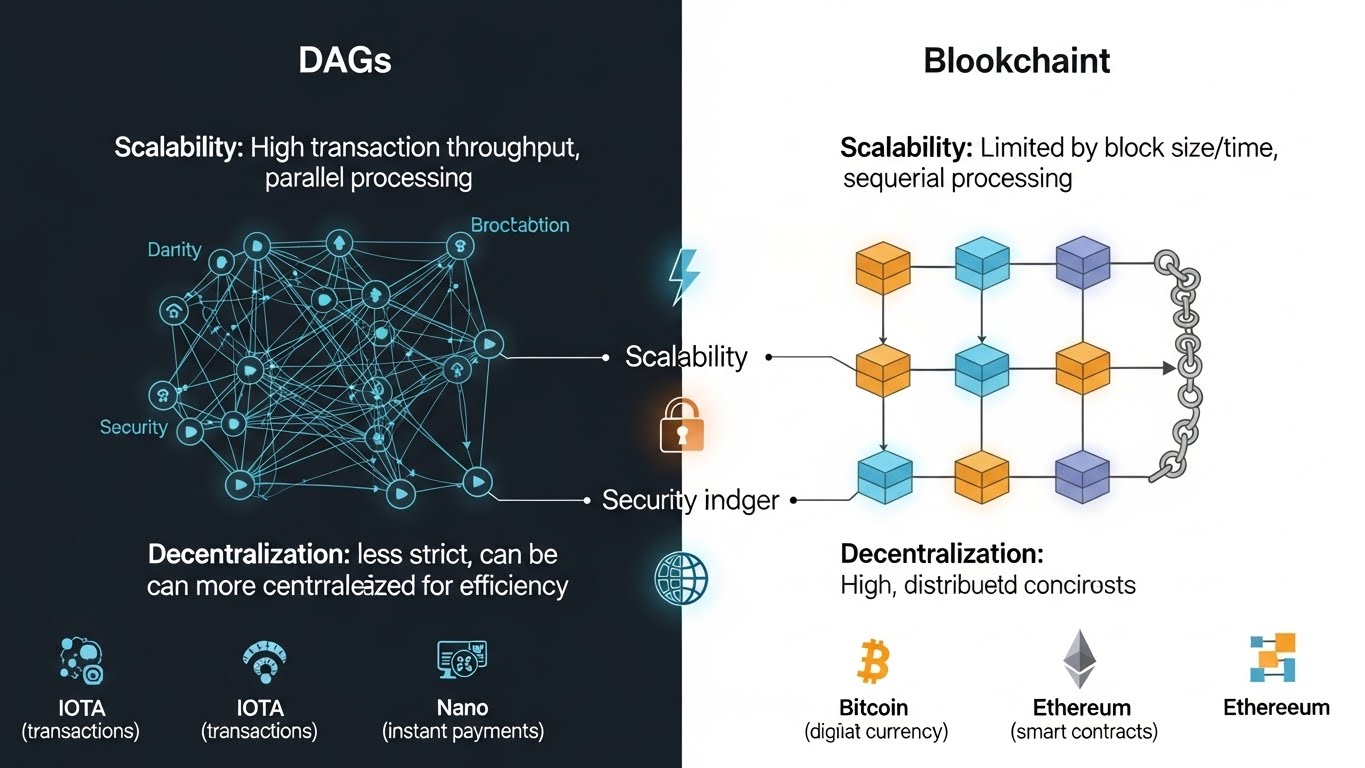
Directed Acyclic Graph technology uses a graph-based structure rather than a linear chain. In a DAG, transactions are nodes connected by directed edges, and there are no cycles, meaning a transaction cannot indirectly reference itself. Each new transaction typically confirms one or more previous transactions. This structure allows multiple transactions to be processed simultaneously rather than sequentially. As a result, DAG-based systems can theoretically scale more efficiently as network activity increases.
How DAG achieves consensus
Instead of traditional block-based consensus, DAG networks often rely on transaction validation by participants themselves. When a user submits a transaction, they validate previous transactions, contributing to network security. This approach reduces the need for miners or validators and can lower transaction fees. DAG-based distributed ledgers are designed to become faster and more secure as more users participate, which contrasts with traditional blockchain bottlenecks.
Directed Acyclic Graph Vs Blockchain architecture
Linear chains versus graph structures
The most fundamental difference in Directed Acyclic Graph Vs Blockchain Technology lies in their architecture. Blockchain organizes data in a single, growing chain, while DAG forms a web-like structure of interconnected transactions. This distinction impacts how data is processed and stored. Blockchain’s linearity ensures order and simplicity, whereas DAG’s graph structure allows parallelism and flexibility.
Impact on scalability and throughput
Scalability is a critical concern for distributed ledgers. Blockchain networks often face congestion during periods of high demand, leading to slow confirmation times and increased fees. DAG systems aim to address this by allowing transactions to validate each other concurrently. As network usage grows, DAG throughput can increase rather than decrease. This characteristic makes DAG appealing for applications requiring high transaction volumes, such as Internet of Things environments.
Security considerations in blockchain and DAG
Blockchain security and immutability
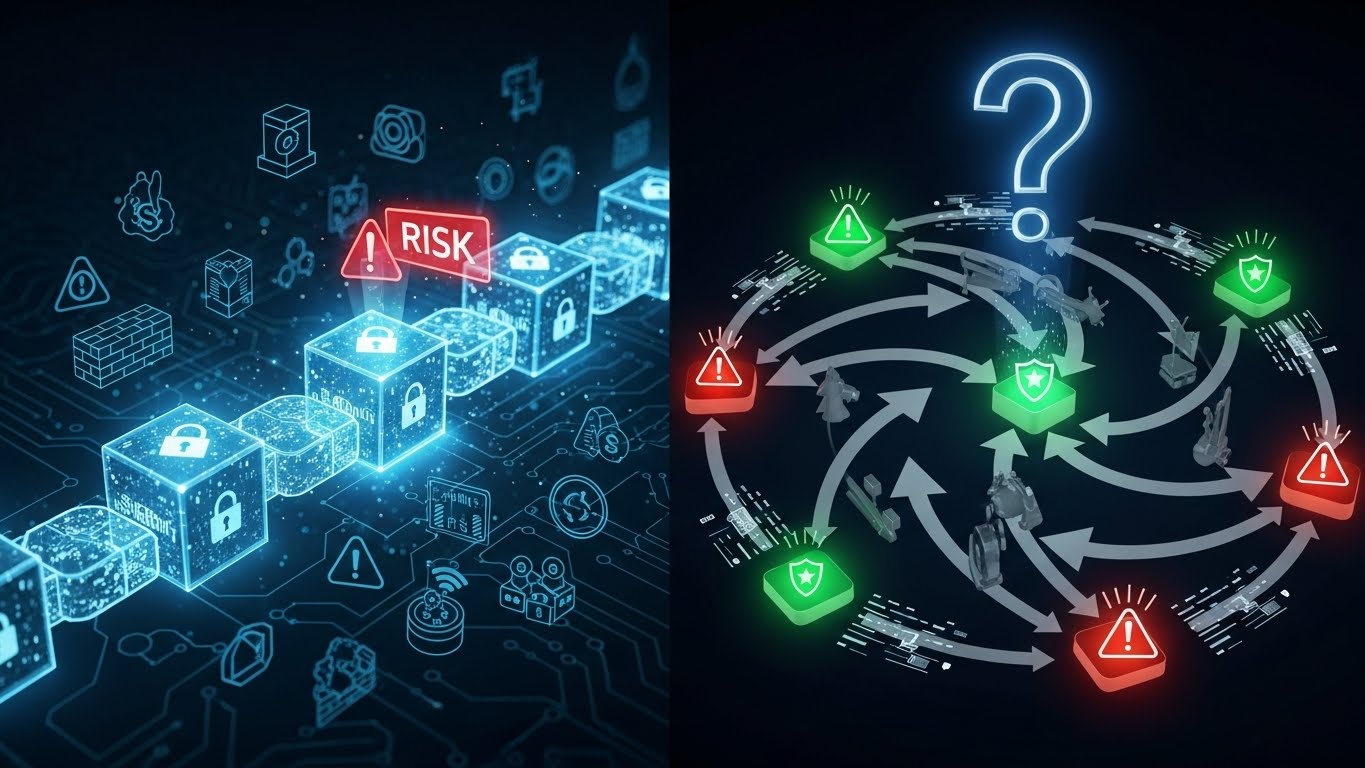
Blockchain security relies on cryptographic hashing and consensus mechanisms. Altering a past transaction would require redoing all subsequent blocks, which becomes infeasible on large networks. This immutability is one of blockchain’s strongest features. Decentralization further enhances security by distributing control across many participants. However, security is closely tied to the network’s size and distribution of power.
DAG security models and challenges
DAG security models differ significantly. Since there are no blocks or miners, security often depends on transaction validation patterns and network activity. Some DAG systems introduce additional mechanisms to prevent attacks during early stages or periods of low activity. While DAG can be secure, its models are often more complex and less battle-tested than traditional blockchain security. This complexity requires careful design and ongoing research.
Transaction speed and efficiency
Blockchain transaction limitations
Blockchain transaction speed is limited by block size and block time. Even with improvements and upgrades, many blockchains struggle to handle large volumes of transactions without congestion. Layer-two solutions attempt to address these limitations, but they add complexity and rely on secondary systems to scale the base layer.
DAG performance advantages
DAG networks excel in transaction speed by design. Since transactions are not constrained by block intervals, confirmation times can be significantly faster. In many implementations, transaction fees are minimal or nonexistent. This efficiency makes DAG suitable for microtransactions and real-time applications where speed is essential.
Decentralization and governance models
Blockchain decentralization dynamics
Blockchain decentralization depends on the distribution of nodes and consensus participants. Well-established blockchains often have large, diverse networks, contributing to resilience and censorship resistance. Governance in blockchain systems can be slow and contentious, as changes require broad agreement. However, this conservatism also protects the network from abrupt or harmful changes.
Governance in DAG systems
DAG governance models vary widely. Some networks emphasize community-driven decision-making, while others rely on foundations or coordinating entities, especially during early stages. This can raise questions about decentralization, but it may also allow faster innovation and adaptation. Balancing decentralization and efficiency remains a central challenge.
Energy consumption and sustainability
Blockchain energy considerations
Energy consumption is a common criticism of certain blockchain systems, particularly those using Proof of Work. High energy usage raises environmental concerns and operational costs. Alternative consensus mechanisms have reduced energy demands, but sustainability remains a key topic in blockchain development.
DAG and energy efficiency
DAG systems are generally more energy-efficient because they do not rely on mining or intensive computation. Transaction validation is lightweight, making DAG appealing for environmentally conscious applications. This efficiency aligns with broader trends toward sustainable technology and green computing.
Real-world use cases and adoption
Blockchain use cases across industries
Blockchain technology has found applications in finance, supply chain management, digital identity, and decentralized applications. Its strong security and immutability make it ideal for scenarios where data integrity is paramount. Despite scalability challenges, blockchain remains the dominant distributed ledger technology due to its maturity and extensive ecosystem.
DAG adoption and emerging applications
DAG adoption is growing in areas requiring high scalability and low fees. Use cases include IoT networks, data integrity systems, and high-frequency transaction environments. While DAG ecosystems are smaller, innovation continues as developers explore its unique capabilities.
Development complexity and ecosystem maturity
Blockchain development environment
Blockchain development benefits from extensive tooling, documentation, and community support. Developers can leverage established frameworks and standards, reducing barriers to entry. This maturity accelerates innovation and supports a wide range of applications.
Building on DAG platforms
DAG development environments are less standardized, which can increase complexity. Developers may need specialized knowledge to design and maintain applications. However, this also creates opportunities for innovation and differentiation as DAG ecosystems evolve.
Directed Acyclic Graph Vs Blockchain future outlook
Coexistence rather than replacement
Rather than replacing blockchain, DAG is likely to coexist as a complementary technology. Each architecture excels in different scenarios, and hybrid systems may combine their strengths. The future of distributed ledgers may involve multiple architectures working together to meet diverse requirements.
Innovation and technological convergence
As research continues, elements of blockchain and DAG may converge. Improvements in consensus, scalability, and interoperability could blur the lines between these technologies. This convergence supports a more flexible and resilient decentralized ecosystem.
Choosing between DAG and blockchain
Factors influencing the choice
Selecting between Directed Acyclic Graph and Blockchain technology depends on use case requirements. Factors such as transaction volume, security needs, decentralization goals, and regulatory considerations all play a role. Understanding these trade-offs helps stakeholders make informed decisions.
Long-term implications for decentralized systems
Both technologies contribute valuable ideas to the evolution of distributed ledgers. Blockchain’s proven security and DAG’s scalability innovations shape how decentralized systems will develop in the coming years. Their ongoing refinement will determine their impact on global digital infrastructure.
Conclusion
The comparison of Directed Acyclic Graph Vs Blockchain Technology highlights two distinct approaches to decentralized ledgers. Blockchain offers proven security, immutability, and a mature ecosystem, making it suitable for applications where trust and transparency are paramount. Directed Acyclic Graph introduces a scalable, efficient alternative designed to handle high transaction volumes with minimal fees.
Neither technology is inherently superior in all scenarios. Instead, they address different challenges within the decentralized landscape. As adoption grows and innovation continues, both blockchain and DAG are likely to play important roles in shaping the future of distributed systems. Understanding their differences empowers developers, businesses, and users to choose the right technology for their needs, fostering a more diverse and resilient decentralized ecosystem.
FAQs
Q: What is the main difference between Directed Acyclic Graph and Blockchain technology?
The main difference lies in structure. Blockchain uses a linear chain of blocks, while Directed Acyclic Graph uses a graph of interconnected transactions. This affects scalability, transaction speed, and consensus mechanisms.
Q: Is Directed Acyclic Graph more scalable than blockchain?
Directed Acyclic Graph is generally more scalable because transactions can be processed in parallel rather than sequentially. This allows throughput to increase as network activity grows, unlike many traditional blockchains.
Q: Does DAG offer the same level of security as blockchain?
DAG can be secure, but its security models differ and are often more complex. Blockchain security is more established and battle-tested, while DAG security depends heavily on network design and participation.
Q: Can blockchain and DAG coexist in the future?
Yes, blockchain and DAG are likely to coexist, serving different use cases. Blockchain may remain dominant for high-security applications, while DAG excels in high-throughput and low-cost environments.
Q: Which technology is better for real-world adoption?
The better choice depends on the application. Blockchain is widely adopted and trusted, while DAG offers performance advantages for specific use cases. Both technologies contribute uniquely to decentralized innovation.
