

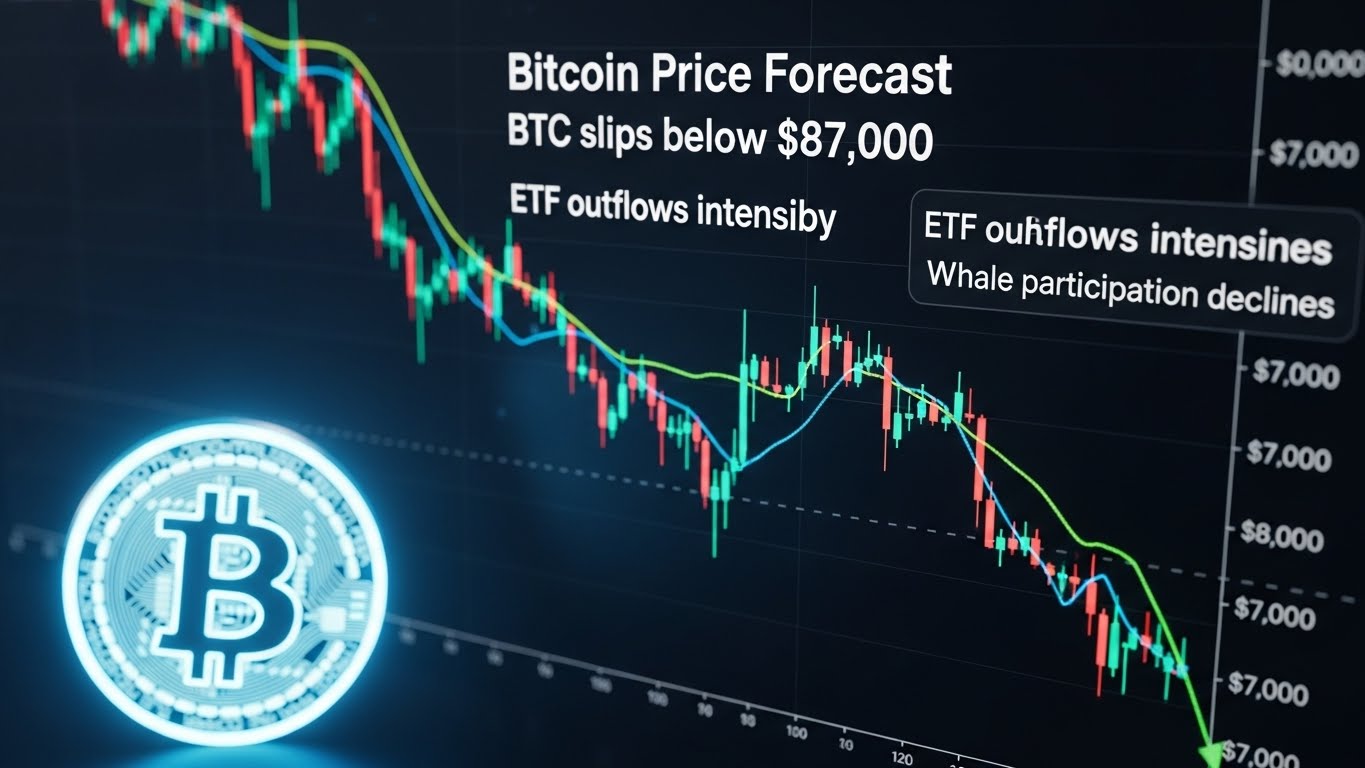
Bitcoin has once again entered a critical phase, with price action slipping below the psychologically important $87,000 level. For many market participants, this move has raised fresh concerns about short-term momentum, especially as ETF outflows continue to accelerate and whale participation shows visible signs of decline. While Bitcoin has weathered numerous corrections throughout its history, the current environment is uniquely shaped by institutional behavior, on-chain dynamics, and shifting macroeconomic expectations. Together, these factors are redefining the near-term Bitcoin price forecast and influencing how investors interpret market risk.
The significance of Bitcoin falling below $87,000 goes beyond a simple technical breakdown. This level had acted as a consolidation zone during recent weeks, providing confidence to both retail traders and institutional investors. As selling pressure increased, largely driven by ETF-related capital movements, the breakdown triggered a reassessment of bullish assumptions. At the same time, declining whale activity suggests that large holders are either stepping back or choosing to wait for clearer signals before re-entering the market. This combination has introduced a cautious tone across the crypto market.
Despite the recent weakness, Bitcoin remains structurally strong in the long-term narrative. Institutional adoption, regulatory clarity in key markets, and its role as digital gold continue to underpin confidence. However, markets do not move in straight lines. Short-term corrections, particularly those influenced by capital rotation and sentiment shifts, are a natural part of Bitcoin’s price discovery process. Understanding the forces behind the current decline is essential for forming a realistic and balanced Bitcoin price forecast.
Bitcoin Price Breakdown Below $87,000 and Market Reaction
Bitcoin’s move below $87,000 marked a decisive shift in short-term market structure. This level had previously served as a support zone where buyers consistently stepped in to absorb selling pressure. Once that support failed, downside momentum increased rapidly, leading to a wave of liquidations and defensive positioning. Traders who were positioned for continuation higher were forced to reassess risk, adding to the selling pressure.
Market reaction was swift and emotionally charged. Sentiment indicators showed a rapid transition from cautious optimism to short-term fear, a common response when key psychological levels are breached. This shift was amplified by declining liquidity during periods of heightened uncertainty, allowing relatively modest sell orders to move price more aggressively. As a result, Bitcoin’s decline appeared sharper than it might have under more balanced market conditions.
The broader crypto market mirrored Bitcoin’s weakness, with major altcoins also experiencing pullbacks. This correlation reinforces Bitcoin’s role as the primary market driver. When Bitcoin shows vulnerability, capital often retreats across the digital asset space, reinforcing a defensive posture among investors. In this context, the Bitcoin price forecast becomes closely tied not only to technical levels but also to broader market confidence.
ETF Outflows and Their Impact on Bitcoin Price Forecast
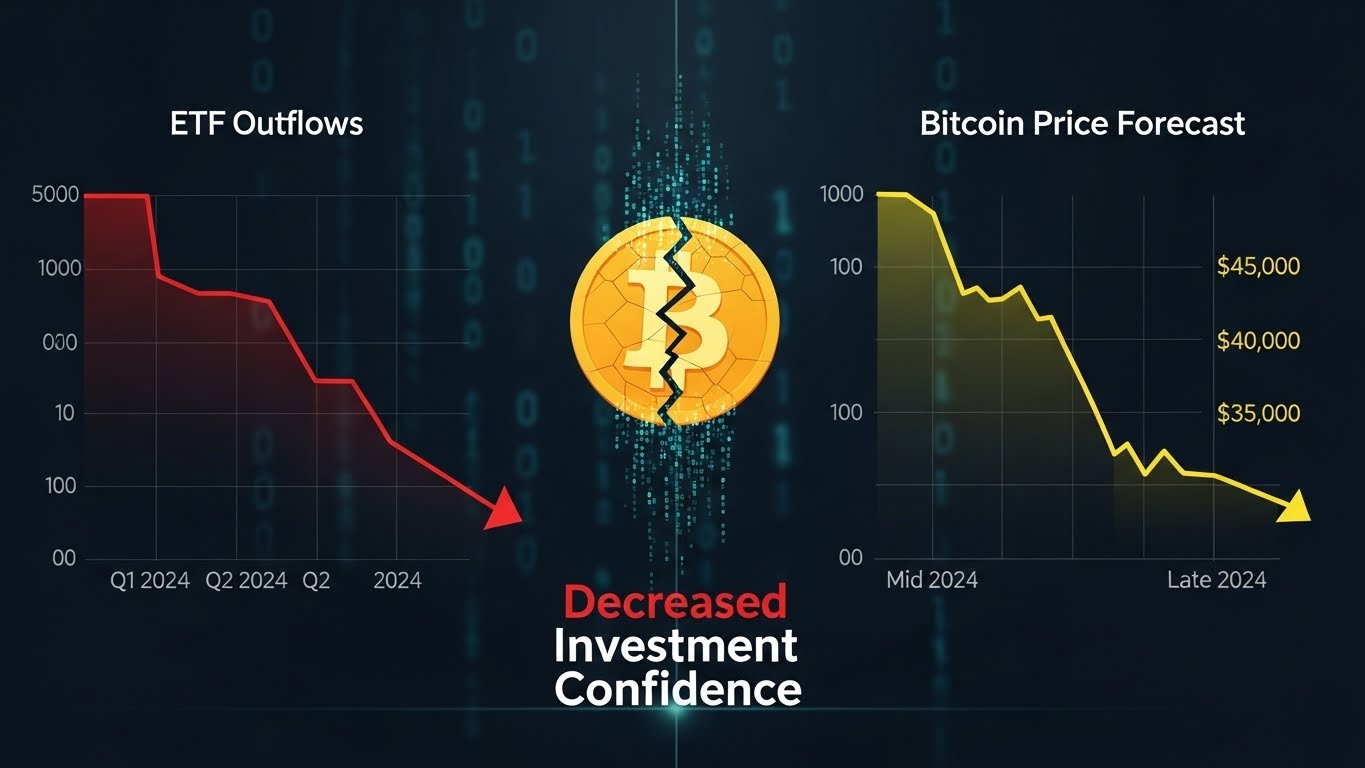
Rising ETF Outflows Signal Institutional Caution
One of the most influential factors behind Bitcoin’s recent weakness has been the intensification of ETF outflows. Bitcoin ETFs have played a transformative role in connecting traditional finance with the crypto market, providing regulated access for institutional and retail investors alike. However, these instruments can also become sources of volatility when capital flows reverse.
ETF outflows signal that a segment of institutional investors is reducing exposure, either to lock in profits or to manage broader portfolio risk. As these outflows increase, they place direct selling pressure on the underlying Bitcoin market. This dynamic has become a critical variable in shaping the current Bitcoin price forecast, as institutional behavior often sets the tone for broader market sentiment.
The reasons behind ETF outflows are multifaceted. Some investors may be responding to macroeconomic uncertainty, including interest rate expectations and global liquidity conditions. Others may be engaging in short-term profit-taking after Bitcoin’s strong performance earlier in the cycle. Regardless of motivation, the net effect is a reduction in demand at a time when technical support levels are already under stress.
How ETF Activity Influences Market Psychology
Beyond direct selling pressure, ETF outflows have a powerful psychological impact on the market. Many traders view ETF flows as a proxy for institutional confidence. When outflows dominate headlines, it reinforces a narrative of caution, encouraging smaller investors to reduce risk exposure. This feedback loop can accelerate downside moves, even if the fundamental outlook remains intact.
In the current environment, ETF-related headlines have contributed to a more conservative Bitcoin price forecast among analysts. Rather than expecting immediate continuation to new highs, many now anticipate a period of consolidation or further downside testing. This shift does not necessarily imply a bearish long-term outlook, but it does highlight the influence of institutional capital flows on short-term price dynamics.
Declining Whale Participation and On-Chain Signals
What Reduced Whale Activity Indicates
Whales, defined as large Bitcoin holders with significant influence over market liquidity, play a crucial role in price discovery. When whale participation declines, it often signals uncertainty or strategic patience among experienced market participants. Recent on-chain data suggests that whale transaction volumes have decreased, aligning with the broader theme of caution.
This decline does not necessarily mean whales are exiting the market entirely. In many cases, reduced activity reflects a wait-and-see approach, where large holders prefer to observe how key levels hold before committing capital. However, in the short term, lower whale participation reduces buy-side support, making the market more vulnerable to downside volatility.
From a Bitcoin price forecast perspective, declining whale activity adds weight to the argument for near-term consolidation. Without strong accumulation from large players, price recovery attempts may lack momentum, increasing the likelihood of range-bound or corrective price action.
On-Chain Metrics and Market Health
Beyond whale activity, broader on-chain metrics provide additional context. Network usage, long-term holder behavior, and exchange balances all contribute to assessing market health. While short-term indicators show weakness, long-term holder supply remains relatively stable, suggesting that conviction among core investors has not materially deteriorated.
This divergence between short-term caution and long-term confidence is a defining feature of the current market. It supports a nuanced Bitcoin price forecast that acknowledges near-term risks while maintaining a constructive long-term outlook. Such conditions often precede periods of consolidation that eventually resolve in the direction of the prevailing macro trend.
Technical Analysis and Key Support Levels
Technical analysis offers valuable insight into where Bitcoin may find stability following its drop below $87,000. The next significant support zones lie in areas where previous consolidation occurred, as well as near widely watched moving averages. These levels often attract buyers looking for favorable risk-reward entries.
Momentum indicators currently suggest oversold conditions on shorter timeframes, which could lead to temporary relief rallies. However, sustained recovery will likely require confirmation through increased volume and renewed institutional interest. Without these elements, upward moves may remain corrective rather than trend-defining.
From a broader perspective, Bitcoin’s long-term uptrend remains intact as long as higher time-frame support levels hold. This reinforces the idea that the current decline, while uncomfortable, may represent a corrective phase rather than a trend reversal. The Bitcoin price forecast therefore hinges on whether buyers can defend these deeper support zones.
Macro Factors Shaping Bitcoin’s Near-Term Outlook

Interest Rates and Global Liquidity
Macroeconomic conditions continue to exert a strong influence on Bitcoin and other risk assets. Expectations around interest rates and central bank policy directly affect investor appetite for speculative and growth-oriented investments. When liquidity tightens or uncertainty rises, assets like Bitcoin often experience increased volatility.
In the current environment, mixed signals from global markets have contributed to cautious positioning. While long-term narratives around digital assets remain compelling, short-term macro headwinds can temporarily overshadow these themes. This context is essential for understanding why ETF outflows and declining whale participation have coincided with Bitcoin’s price decline.
Risk Sentiment Across Financial Markets
Bitcoin’s correlation with broader risk sentiment has evolved over time. While it retains unique characteristics, it is increasingly influenced by movements in equities and other macro assets. Periods of heightened risk aversion often translate into selling pressure across multiple asset classes, including cryptocurrencies. This interconnectedness reinforces the importance of monitoring global market trends when forming a Bitcoin price forecast. Short-term weakness in Bitcoin may reflect broader shifts in investor behavior rather than crypto-specific issues. Recognizing this distinction helps avoid overreacting to price movements driven by external factors.
Short-Term vs Long-Term Bitcoin Price Forecast
In the short term, Bitcoin faces clear challenges. ETF outflows, declining whale participation, and weakened technical structure suggest that volatility is likely to remain elevated. Price action may continue to test lower support levels before a sustainable base is established. This scenario aligns with a cautious near-term Bitcoin price forecast that emphasizes consolidation and risk management.
In the long term, however, Bitcoin’s fundamental narrative remains strong. Scarcity, growing institutional integration, and its role as a hedge against monetary debasement continue to attract interest. Historically, periods of consolidation and correction have often preceded renewed uptrends, particularly when long-term holders maintain conviction.
Balancing these perspectives is essential for investors. Short-term traders may focus on volatility and technical levels, while long-term investors may view the current dip as part of a broader accumulation phase. Both approaches can coexist, reflecting the diverse strategies within the Bitcoin market.
Conclusion
Bitcoin slipping below $87,000 has introduced renewed uncertainty into the market, driven by intensifying ETF outflows and declining whale participation. These factors have weakened short-term momentum and reshaped the immediate Bitcoin price forecast toward caution and consolidation. However, the broader context suggests that this move is part of a natural corrective process rather than a fundamental breakdown. While near-term volatility may persist, long-term structural strength remains intact, supported by ongoing adoption and resilient holder behavior. As always, understanding both short-term dynamics and long-term trends is key to navigating Bitcoin’s evolving market landscape.
FAQs
Q: Why did Bitcoin fall below $87,000 despite strong long-term fundamentals?
Bitcoin fell below $87,000 due to short-term pressures such as ETF outflows, declining whale participation, and weakened technical support. These factors can temporarily override long-term fundamentals, especially during periods of heightened uncertainty and reduced liquidity.
Q: How do ETF outflows affect the Bitcoin price forecast?
ETF outflows directly increase selling pressure and signal institutional caution. This influences market psychology and often leads analysts to adopt a more conservative Bitcoin price forecast in the short term, even if long-term prospects remain positive.
Q: What does declining whale participation mean for Bitcoin’s price?
Declining whale participation suggests that large holders are exercising caution or waiting for clearer signals. This reduces immediate buy-side support, making Bitcoin more vulnerable to downside volatility and slower recoveries in the near term.
Q: Is the current Bitcoin price decline a sign of a trend reversal?
At this stage, the decline appears more consistent with a corrective phase rather than a full trend reversal. Long-term support levels and holder behavior indicate that the broader uptrend may still be intact, despite short-term weakness.
Q: How should investors approach the current Bitcoin market conditions?
Investors should balance caution with perspective. Short-term traders may focus on managing volatility and key support levels, while long-term investors may view the dip as part of a normal market cycle, emphasizing fundamentals over short-term price movements.
