

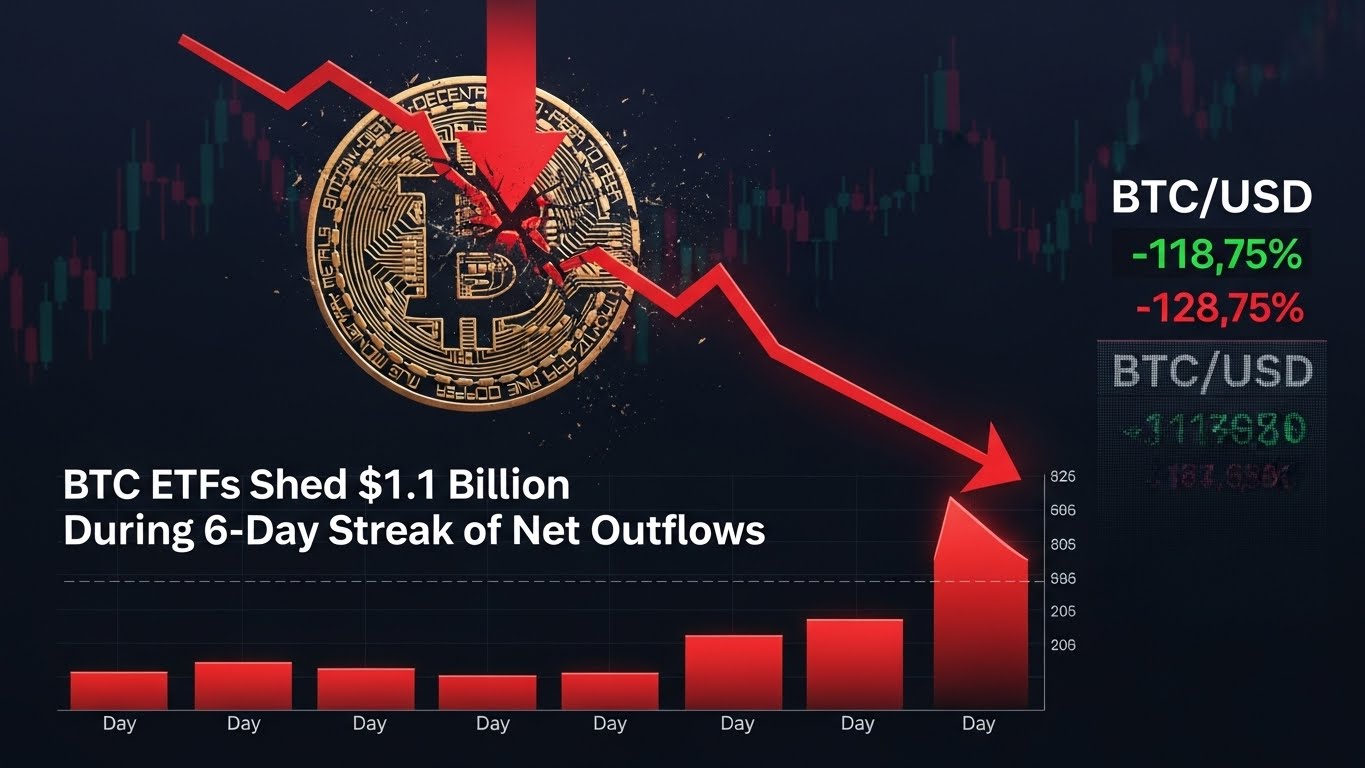
Bitcoin price news moves fast, but few developments shape sentiment as strongly as ETF flows. When BTC ETFs shed $1.1 billion during a six-day streak of net outflows, it sends a clear message to the market: institutional demand is pausing, reallocating, or stepping back—at least temporarily. Because U.S.-listed spot Bitcoin ETFs have become one of the most visible entry points for professional capital, their inflows and outflows are now treated like a daily scoreboard for Bitcoin’s broader adoption story.
At first glance, six straight days of net outflows looks like a bearish signal that investors are losing faith. But a deeper look shows why this “Bitcoin price news” story is more complex than a simple yes-or-no judgment on Bitcoin. ETF outflows can happen for many reasons: profit-taking after a rally, rebalancing portfolios at month-end, risk reduction after macro shocks, or even investor rotation into other assets. Still, when the outflows are large and persistent, the market pays attention because they directly affect short-term liquidity and influence price stability.
The most important part of this Bitcoin price news headline is not just the number. It’s the timing and the streak. A six-day run of net outflows suggests the market isn’t dealing with a one-off event. It’s reacting to a narrative shift, a macro shift, or both. That’s why traders and long-term holders alike are watching this metric. ETF flows often serve as the bridge between traditional finance and crypto-native markets, and when that bridge shows heavy traffic moving out, the impact is felt across exchanges, derivatives markets, and altcoins.
In this article, we’ll break down what it means when BTC ETFs shed $1.1 billion during a six-day streak of net outflows, how it relates to Bitcoin price action, why institutional flows matter so much, and whether these outflows are a warning sign or simply a temporary reset. You’ll also learn how to interpret ETF flow data responsibly and what signals to watch next.
What It Means When BTC ETFs Shed $1.1 Billion in Net Outflows
When BTC ETFs shed $1.1 billion, it means that more money left these exchange-traded funds than entered them during the period being measured. The headline focuses on a six-day streak because consecutive outflows typically create stronger market pressure than a single day of withdrawals. In practical terms, investors were redeeming shares or selling ETF positions at a faster pace than new buyers were stepping in.
This matters because spot Bitcoin ETFs hold actual Bitcoin. When ETF issuers experience net outflows, they often need to sell Bitcoin or adjust holdings to meet redemptions. That doesn’t always happen instantly or in a direct one-to-one manner due to the mechanics of authorized participants, settlement timing, and hedging activity. But the market interprets sustained outflows as a potential source of sell pressure, especially in an environment where liquidity is already thinning.
This Bitcoin price news event also reflects psychology. ETFs are widely viewed as “smart money” vehicles, even if retail investors also use them. When outflows appear, traders assume institutions are pulling back. That assumption influences sentiment and can make price action more fragile. The result is often higher volatility, more aggressive short-term positioning, and increased risk of cascading liquidations in crypto derivatives markets.
This is why ETF outflows aren’t just a statistical detail. They’re a narrative force. When people see BTC ETFs shed $1.1 billion, they connect it to the idea that the market’s most sophisticated participants are reducing exposure. Sometimes that interpretation is correct, and sometimes it’s a misunderstanding of how money moves through the ETF ecosystem. Either way, price reacts because perception becomes reality in the short run.
The Difference Between Daily Outflows and a Multi-Day Outflow Streak
A single day of net outflows can be dismissed as noise. It can reflect a temporary hedge unwind, a profit-taking session, or a short-term shift in risk appetite. A six-day streak, however, suggests repeated selling pressure and sustained caution. When outflows continue for several sessions, it implies that buyers are not absorbing supply at the same pace. This can create a feedback loop where lower prices encourage more selling, and more selling strengthens bearish sentiment. That dynamic is why streaks matter as much as totals in Bitcoin price news coverage.
Why ETF Flows Have Become a Key Driver of Bitcoin Price News

Spot Bitcoin ETFs changed the market structure by allowing investors to gain Bitcoin exposure through regulated exchanges without holding Bitcoin directly. That matters because many institutional investors have mandates, compliance requirements, or custody limitations that make direct crypto holdings difficult. ETFs solved that problem and unlocked a new wave of participation.
Now, daily ETF flow updates are treated like macro indicators for Bitcoin. They signal demand conditions and the presence or absence of institutional appetite. When inflows are strong, it supports bullish price action because it suggests steady demand. When outflows dominate, it signals caution, and Bitcoin’s price becomes more vulnerable to pullbacks.
Bitcoin price news is heavily influenced by narratives. ETFs provide a simple narrative: “money in” equals demand, “money out” equals selling. Real markets are more complex, but simple narratives move fast in trading environments. This is why ETF flow headlines can move price even if the underlying fundamentals haven’t changed.
Another reason ETFs matter is because they influence liquidity and volatility. If ETF demand is weak, Bitcoin’s price may rely more on crypto-native liquidity, which can be thinner and more leverage-driven. That can result in sharper moves in both directions.
How ETF Flows Affect Market Sentiment and Momentum
Markets respond not only to facts but to expectations. A persistent outflow streak signals that large investors may be reducing risk, even if the reason is routine. That perception impacts momentum traders, who often follow flows as confirmation signals. When BTC ETFs shed $1.1 billion, many traders interpret it as a momentum break. They may reduce long positions, increase hedges, or rotate into stablecoins. The result is lower buying pressure, which reinforces the outflow narrative.
The Possible Reasons Behind the 6-Day Net Outflow Streak
To understand this Bitcoin price news event properly, you need to understand why ETF outflows happen. Outflows do not always mean investors are permanently abandoning Bitcoin. Often, they reflect positioning decisions tied to broader market forces. One major reason is profit-taking. If Bitcoin rallied earlier in the year, many investors may have locked in gains. ETFs make that easy because investors can sell shares instantly during market hours. When a large group takes profits, net outflows rise.
Another reason is portfolio rebalancing. Institutions frequently adjust allocations at quarter-end, month-end, or during periods of rising volatility. If Bitcoin is viewed as a risk asset, it may be trimmed when uncertainty increases. A third reason is macro-driven risk reduction. If bond yields rise, if inflation concerns return, or if equities become unstable, investors often reduce exposure to volatile assets. Bitcoin tends to be one of the first assets trimmed in a “risk-off” shift because it can drop quickly and move sharply.
ETF outflows may also reflect rotation. Some investors may shift from Bitcoin ETFs into other crypto exposures, such as Ethereum products, blockchain equities, or structured strategies. Outflows can also occur when investors replace ETF exposure with futures-based exposure for tax or hedging reasons. These possibilities explain why the headline “BTC ETFs shed $1.1 billion” should not automatically be read as permanent bearishness. But the streak still matters because it changes short-term supply and demand conditions.
Why Holiday Weeks and Thin Liquidity Can Amplify Outflows
Outflow streaks often occur during periods of thinner liquidity, such as holidays or year-end sessions, when fewer buyers are active. In those environments, even modest selling can look large because there is less demand to absorb it. Thin liquidity also increases volatility. That volatility can trigger risk management rules at institutions, which can lead to more selling. This is one way a streak can sustain itself.
How ETF Outflows Influence Bitcoin Price Volatility
Bitcoin price volatility is shaped by liquidity, leverage, and sentiment. ETF outflows impact all three. When BTC ETFs shed $1.1 billion, it signals that a major source of liquidity is moving out rather than in. That can widen spreads, reduce depth on order books, and make price moves more abrupt.
Outflows also influence leverage. When price drops due to selling pressure, leveraged long positions may get liquidated. Those liquidations add forced selling, pushing price lower. This is why Bitcoin often experiences sharp drawdowns during outflow streaks. It’s not only the ETF selling itself, but the derivative chain reaction it can trigger.
Another important effect is psychological. When ETF outflows are persistent, traders become more defensive. They reduce risk, stop buying dips aggressively, and wait for confirmation that selling has ended. That shifts the market from “buy the dip” behavior to “wait and see” behavior, which can extend corrections.
Why the Spot ETF Market Is Now a Volatility Amplifier
Spot ETFs were expected to stabilize Bitcoin by bringing long-term investors into the market. And in some ways they do. But ETFs can also amplify volatility because they make it easier to enter and exit positions quickly. If investors view Bitcoin as a tactical allocation rather than a long-term holding, flows can swing sharply. This is why Bitcoin price news coverage now watches ETFs almost like a heartbeat monitor. When inflows stop and outflows begin, volatility tends to rise.
Institutional Behavior: What Big Investors Might Be Signaling
Institutional investors are not a single group with one strategy. Some are long-term allocators. Some are hedge funds trading momentum. Some are arbitrage desks exploiting basis trades. ETF flows represent the combined behavior of many different participants.
Still, when outflows are sustained, it often suggests that institutions are either reducing risk or shifting strategies. They might be hedging a macro downturn. They might be reducing exposure before a major event. They might be reallocating to other assets that offer better risk-adjusted returns.
It’s also possible that some investors are moving from ETFs to direct custody holdings or private funds, depending on regulatory and operational preferences. That means ETF outflows do not necessarily mean capital is leaving Bitcoin entirely. It can mean capital is leaving the ETF wrapper. However, the market usually reacts as if outflows mean bearishness because the ETF wrapper is one of the most visible proxies for institutional demand. That’s why this story remains dominant in Bitcoin price news.
The Role of Authorized Participants and Arbitrage in ETF Flows
ETF creation and redemption processes involve authorized participants who manage the flow between ETF shares and the underlying Bitcoin. These participants may redeem shares when discounts appear or when it’s profitable to arbitrage price differences. This means some outflows may be driven by market-making mechanics rather than investor fear. But even if outflows are mechanical, they still affect Bitcoin’s short-term supply and price behavior.
Impact on Altcoins: Why Bitcoin ETF Outflows Often Hit the Entire Market
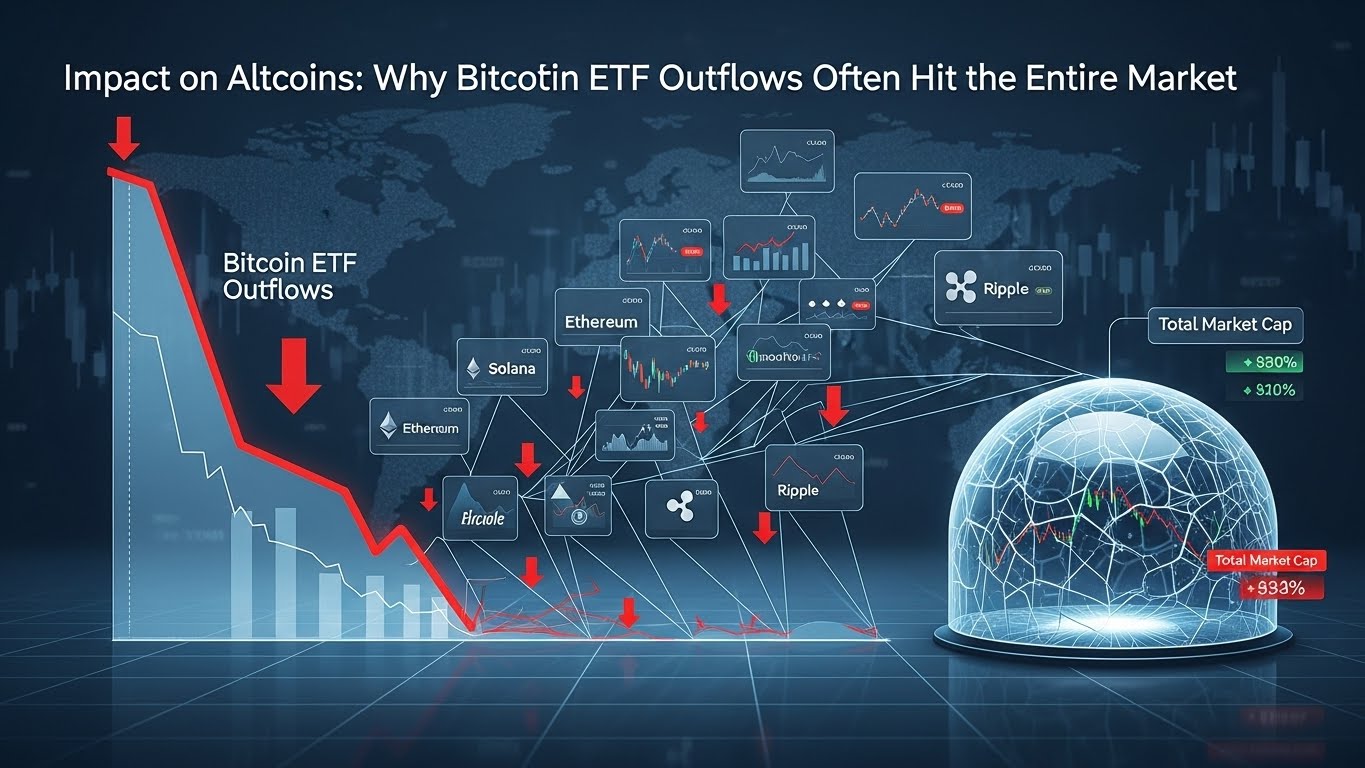
When Bitcoin weakens, altcoins usually weaken more. This happens because altcoins are riskier, less liquid, and more sentiment-driven. If ETF outflows push Bitcoin lower, capital often leaves the broader crypto market entirely, not just Bitcoin.
This is why Bitcoin price news often becomes altcoin news. A major outflow streak can trigger a shift into stablecoins, reduce liquidity in altcoin pairs, and increase selling pressure across the board. In many cases, the correlation between Bitcoin and altcoins rises during downturns. Altcoin weakness can also reinforce Bitcoin weakness. When altcoins drop sharply, it increases fear in the crypto ecosystem, pushing more investors to reduce exposure. That creates a broad market slump. The result is that a story about BTC ETFs shedding $1.1 billion can ripple through the entire crypto market, affecting everything from large-cap networks to small speculative tokens.
How Risk Appetite Shifts During ETF Outflow Phases
In inflow phases, traders take risk. They buy altcoins, use leverage, and chase momentum. In outflow phases, traders reduce risk. They move into Bitcoin, stablecoins, or even leave crypto entirely. This shift compresses altcoin valuations and makes recoveries slower until confidence returns.
Is This a Bearish Signal or a Temporary Reset?
This is the most important question for readers of Bitcoin price news. When BTC ETFs shed $1.1 billion during a six-day streak of net outflows, does it mean a larger bear market is starting, or is it just a temporary reset?
The answer depends on what happens next. If outflows continue, it may signal that the market is facing deeper structural selling, possibly tied to macro weakness or a re-rating of risk assets. If outflows slow and inflows return, the streak may be viewed as a short-term event driven by profit-taking and seasonal factors. It also depends on Bitcoin’s price structure. If Bitcoin holds key support levels, outflows may have limited long-term impact. If Bitcoin breaks important support zones, outflows can accelerate and trigger further downside.
Finally, the broader macro environment matters. If inflation expectations rise, if yields climb, or if global risk sentiment turns negative, outflows could persist. If conditions improve, investors may return to Bitcoin exposure quickly because ETFs make that easy. In other words, ETF outflows are not destiny. They are a signal. But like any signal, they must be interpreted with context.
What to Watch Next in Bitcoin Price News
The next signals that matter are whether net outflows continue, whether Bitcoin holds key price levels, and whether derivatives funding rates and liquidation data show stabilization. If ETF flows flip back to net inflows, it often acts as a confidence boost and can trigger renewed momentum buying.
How Long-Term Investors Should Interpret ETF Outflows
Long-term Bitcoin investors tend to see outflow streaks differently from short-term traders. For them, outflows can represent noise within a broader adoption trend. They may even see it as an opportunity if they believe Bitcoin’s long-term scarcity and network strength remain intact. However, long-term investors should still respect the role of flows because flows impact price. Even if your thesis is multi-year, ETF outflows can create painful drawdowns. Understanding them helps you manage expectations and plan entries responsibly.
The key is not to overreact. ETF outflows are one metric. They should be viewed alongside on-chain activity, macro conditions, network fundamentals, and overall market structure. In many cycles, Bitcoin has experienced multiple sharp drawdowns before resuming its long-term trend. Outflow streaks can be part of that normal process.
The Bigger Picture: Adoption vs Short-Term Capital Movement
ETF outflows reflect short-term capital movement. Adoption reflects long-term integration. A temporary wave of outflows does not necessarily reverse adoption trends. But it can reshape sentiment and delay price recovery. This is why the best approach is balance: take flows seriously, but don’t let them rewrite your entire view of Bitcoin’s future.
Conclusion
Bitcoin price news is increasingly driven by ETF flows because ETFs represent one of the largest bridges between traditional finance and crypto markets. When BTC ETFs shed $1.1 billion during a six-day streak of net outflows, it signals a shift in short-term demand that can influence liquidity, volatility, and sentiment.
But outflows do not automatically mean that Bitcoin’s long-term story is collapsing. They can reflect profit-taking, portfolio rebalancing, macro uncertainty, thin liquidity, or mechanical arbitrage. The real question is what happens next: whether flows stabilize, whether Bitcoin holds key support levels, and whether institutional appetite returns as conditions change.
For investors, this moment is a reminder that Bitcoin remains a fast-moving, sentiment-driven asset—even in an era of regulated ETFs. The smartest move is to interpret ETF flows with context, watch broader indicators, and focus on risk management rather than headline fear. In the long run, Bitcoin’s value will depend on adoption and utility, not just daily ETF inflows and outflows. But in the short run, these flows are one of the most powerful forces shaping price direction.
FAQs
Q: Why is this Bitcoin price news about BTC ETFs shedding $1.1 billion so important?
This Bitcoin price news matters because spot Bitcoin ETFs are now one of the main channels for institutional and mainstream investor exposure. When BTC ETFs shed $1.1 billion during a six-day net outflow streak, it signals that demand through this major channel has weakened temporarily. That shift can reduce liquidity, increase volatility, and influence market sentiment. Even if long-term adoption remains strong, short-term price action often reacts strongly because ETF flows are seen as a proxy for institutional confidence.
Q: Does a 6-day streak of net outflows mean institutions are abandoning Bitcoin?
Not necessarily. A six-day outflow streak can reflect many things besides abandonment, including profit-taking after a rally, portfolio rebalancing, macro risk reduction, or rotation into other assets. Some funds also adjust exposure tactically depending on interest rates, inflation expectations, or volatility in equities. While the streak is a caution signal, it doesn’t automatically mean institutions are permanently bearish on Bitcoin. The next few flow sessions and price reactions provide more clarity.
Q: How do Bitcoin ETFs outflows actually impact BTC price and volatility?
When BTC ETFs shed $1.1 billion, the ETF ecosystem may need to reduce underlying Bitcoin exposure through redemptions and adjustments, which can add selling pressure. More importantly, sustained outflows often weaken sentiment and discourage dip buying. Lower demand combined with defensive positioning can make Bitcoin more volatile, especially if derivatives markets are heavily leveraged. If price falls far enough, liquidations can accelerate the move, creating sharp intraday swings.
Q: Can Bitcoin recover even if ETF outflows continue for several more days?
Bitcoin can recover, but extended outflows make recovery harder because they reduce a major source of consistent demand. If macro conditions improve, risk appetite returns, and buyers step in on exchanges and ETFs, price can stabilize even during choppy flow periods. However, if outflows remain heavy while broader markets turn risk-off, Bitcoin may struggle to regain momentum quickly. Recovery usually becomes more likely when outflows slow and ETF flows begin to normalize.
Q: What should investors watch after this Bitcoin price news event to understand what comes next?
Investors should watch whether ETF flows remain negative or flip back to net inflows, because a reversal often improves sentiment. They should also track Bitcoin’s key support and resistance zones, derivatives funding rates, liquidation data, and broader macro indicators like bond yields and risk sentiment in equities. If flows stabilize and price holds support, the outflow streak may be remembered as a temporary shakeout rather than the start of a deeper downturn.
